

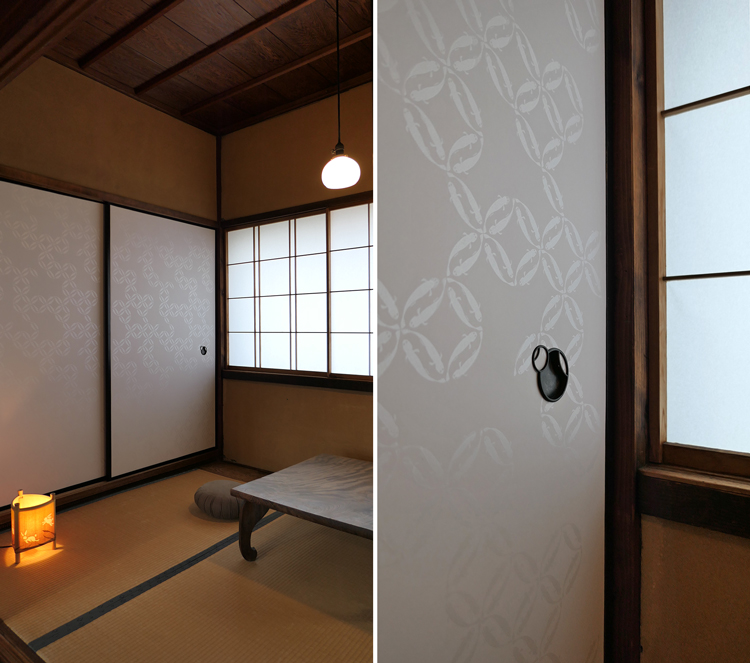
金沢からかみは、金沢の文化や自然をもとにした模様を、和紙に一枚ずつ手で摺ってつくる建材です。主に襖に使われるほか、壁面など、建築の一部として使われます。
金沢には、藩政期から続く表具の歴史があります。加賀藩には御用を務めた表具師の記録も残されており、掛軸や屏風、襖など、紙や布を建築や暮らしの中に仕立てる技術が、長い年月にわたって受け継がれてきました。
一方で、そうした技術がありながら、「金沢のからかみ」として、金沢にゆかりのある模様をまとめたものはありませんでした。
北陸新幹線の金沢開業を控えた2011年、金沢からかみ研究会が発足し、金沢の文化や自然から模様を選び、新たな型をつくる取り組みが始まりました。長く受け継がれてきた金沢の表具の技術を土台に、金沢らしい模様をあらためて選び、現代の建築に使うものとしてまとめたのが、現在の金沢からかみです。
なぜ、シルクスクリーンなのでしょう
シルクスクリーンは、ポップアートの巨匠アンディ・ウォーホルが作品制作に用いたことでも有名です。一方で、網目と型を介して、必要な部分だけに材料を置いて模様をつくるという考え方には、日本で古くから行われてきた型染めとも通じるところがあります。木版に比べれば新しい技法ですが、その歴史はすでに100年以上になります。
金沢には藩政期から続く表具の歴史があります。その技術を受け継ぐ表具師たちが、あらたに金沢のからかみをまとめるにあたり、昔の方法をそのまま再現するのではなく、シルクスクリーンという技法を選び直しました。
古くからある材料や技術と、ポップアートをも連想させるシルクスクリーンが、ここであらためて出会っていることも、金沢からかみの面白さのひとつです。
なぜ、手で摺るのでしょう
金沢からかみが現在も職人の手で摺られているのは、単に伝統的な方法を残すためではありません。
現在の印刷技術を使っても、同じものをつくることのできる印刷機械がないためです。
襖に使う和紙は大きく、表面には独特の凹凸があります。さらに、雲英と糊を混ぜた材料を、模様の部分にのせて定着させる工程は、一般的なインクを使った印刷とは異なります。
紙の大きさ、和紙の表面、雲英(きら)という素材、そして摺りに必要な工程。
これらを一度に扱うことのできる印刷機械がないため、シルクスクリーンを使い、職人が一枚ずつ手で摺っています。
つまり手摺りは、昔の方法をあえて選んでいるのではなく、この素材と大きさでつくるために、現在も必要な技術なのです。
どう見えるのでしょう
雲英で摺られた模様は、金属のように強く光るわけではありません。
細かな雲母が光を受けると、模様の部分だけがやわらかく光を反射します。
そのため、光の当たる方向や見る角度によって、それまで目立たなかった模様がふっと浮かび上がったり、反対に静かに見えなくなったりします。
白や淡い色の和紙の上に、色で模様を強く描くのではなく、光によって模様が現れるような見え方です。
きらめきがあっても派手にならないのは、このためです。
なぜ、建築に使うのでしょう
金沢からかみは、紙そのものを眺めるためだけのものではありません。
襖や壁のような大きな面に使うと、その面全体が室内の光を受けます。朝と夕方、晴れの日と曇りの日、見る場所によって、雲英の模様の見え方も少しずつ変わります。
つまり、模様のある和紙を部屋に取り入れ、その和紙を絵画のように鑑賞するというよりは、雲英で摺られた模様が光を受けて反射することで、その周囲を含めた光の表情が変わっていく。その空間の変化そのものに、たのしみがあります。
とくに襖は、人の目に近い大きな面であり、開け閉めによって位置も変わります。朝と夕方、晴れの日と曇りの日、襖の位置や見る場所によって、光の反射も変化します。
光と模様が働き合い、室内全体の光のあり方が静かに変わっていくことも、金沢からかみの魅力です。
そうした日本の室内建築の中で、空間そのものに表情をつくる建材としての魅力があります。
金沢からかみをもっと知る | 柄を見る | 注文の方法を見る
What is Kanazawa Karakami?
Kanazawa Karakami is an architectural material made by hand screen-printing patterns inspired by the culture and nature of Kanazawa onto sheets of washi paper. It is used mainly for fusuma sliding doors, as well as for walls and other interior architectural surfaces.
Kanazawa has a long history of hyogu, the specialist craft of mounting, finishing, and restoring paper and textiles for hanging scrolls, folding screens, fusuma, and other elements of Japanese interiors. Records survive of hyogu artisans who worked for the Kaga domain during the feudal period, and these skills have been passed down through generations.
What had not existed, however, was a collection of karakami patterns brought together specifically as “Kanazawa” designs.
In 2011, as the city prepared for the opening of the Hokuriku Shinkansen to Kanazawa, the Kanazawa Karakami Research Group was established. Patterns connected with the culture, architecture, and natural environment of Kanazawa were selected and developed for use in contemporary interiors.
Kanazawa Karakami is therefore not something that has existed unchanged for hundreds of years. It brings together the long-established skills of Kanazawa’s hyogu artisans with patterns selected and developed for use in architecture today.
One of its distinctive features is that the patterns themselves are printed with kira.
Kira is made from finely processed mica, a naturally occurring mineral. It is mixed with a binder and applied through a silkscreen only to the parts of the washi that form the pattern.
As a result, the entire sheet does not shine. Instead, the mica-printed pattern softly reflects the light.
Why is silkscreen used?
Silkscreen is perhaps best known through modern art, especially the work of Andy Warhol. Yet the basic idea behind the technique—using a mesh and a stencil so that material is applied only to selected areas—also has something in common with traditional Japanese stencil-dyeing methods that have been used for centuries. Compared with woodblock printing, silkscreen is a newer technique, but it already has a history of more than a hundred years.
Kanazawa, meanwhile, has a history of hyogu dating back to the feudal period. When the hyogu artisans who inherited those skills reconsidered and reorganized Kanazawa karakami in the 2010s, they did not simply reproduce an older method. Instead, they chose silkscreen as the technique best suited to what they wanted to make.
There is something particularly interesting in this meeting: long-established materials and craft knowledge, brought together with a technique that may also call to mind the world of Pop Art. That unexpected crossing of histories is part of the character of Kanazawa Karakami.
Why is it printed by hand?
Kanazawa Karakami is still printed by hand today not simply to preserve a traditional method.
Even with modern printing technology, there is currently no printing machine that can reproduce the same process.
The sheets of washi used for fusuma are large, and their surfaces have a distinctive texture and unevenness. Unlike ordinary printing paper, they cannot easily be fed through a machine at a constant speed.
Kira also behaves differently from ordinary printing ink. Finely processed mica is mixed with a binder and applied only to the patterned areas of the washi.
The size of the paper, the texture of the washi, the properties of mica, and the printing process all have to be handled together.
Because no existing printing machine can accommodate all of these conditions at once, each sheet is screen-printed individually by hand.
In other words, hand screen-printing Kanazawa Karakami is not simply a choice to preserve an old technique. It remains necessary in order to produce this material at this scale and with these characteristics.
What does it look like?
The kira pattern does not shine strongly like metal.
When the fine mica particles catch the light, only the printed pattern reflects it softly.
Depending on the direction of the light and the viewing angle, a pattern that was barely visible may gently emerge, or seem to fade again.
Rather than defining the pattern through strong differences in color alone, Kanazawa Karakami allows the pattern to appear through differences in reflected light.
This is why it can shimmer without feeling flashy, and why it blends naturally into an interior.
Why is it used in architecture?
Rather than bringing patterned washi into a room simply to admire the paper itself as one might admire a painting, Kanazawa Karakami offers another kind of experience. As the kira-printed patterns catch and reflect light, they subtly change the quality of light around them. The pleasure lies in experiencing the space itself as it changes.
Fusuma are particularly suited to this effect. They form large surfaces close to eye level, and their position changes as they are opened and closed. The reflected light also changes between morning and evening, on sunny and cloudy days, and depending on the position of the fusuma and where the viewer is standing.
As light and pattern interact, the quality of light throughout the room changes quietly and subtly.
This is one of the particular qualities of Kanazawa Karakami: it does not simply decorate a surface, but can give expression to the space around it.
Fusuma are one way to experience this quality, but not the only one. Kanazawa Karakami can also be used on walls, panels, hanging scrolls, and in other forms that allow the pattern to interact with the light and the surrounding space.
Learn More About Kanazawa Karakami | View the Patterns | How to Order
